If your ladder keeps shifting at the gutter, it’s not bad luck. It’s usually one of a few fixable things.
To stop a ladder sliding on the gutter, secure the top and the base. At the top, clamp the gutter edge, tie to a rigid support, or use a standoff. At the base, set up on firm ground at the right angle and secure the feet.
You set the ladder, start climbing, and near the top you feel it: a small shift sideways at the gutter. For many people, that moment is what makes ladder work feel risky.
Below, we look at why it happens and each option in detail.
Why the Top Slides
The top of an extension ladder usually rests on a gutter edge. That’s a narrow, often curved surface, with only the two rails touching it. There isn’t much holding the ladder in place, so small forces can move it.
The most common causes:
- Wet gutters. Rain, dew, leaves and grime make the gutter edge slippery, so the rails have less grip.
- The wrong ladder angle. Too steep, and the ladder can feel unstable at the top. Too shallow, and the base can slide out. A common rule is 4 to 1: set the base 1 foot out for every 4 feet of height.
- Over-reaching. Leaning out to one side shifts your weight and pushes the top of the ladder sideways. Keep your body centered between the rails.
- Stepping on and off at the top. Moving from the ladder onto the roof, or back again, puts sideways force on the ladder right where it has the least grip.
Why Improvised Fixes Fail
When a ladder shifts, it’s tempting to reach for whatever’s nearby. Common quick fixes include:
- Tying the ladder to the gutter or a downpipe. Gutters and downpipes aren’t built to be anchor points. OSHA’s ladder standard calls for a rigid support that won’t deflect, and a gutter may bend or pull away under load.
- Using bungee cords or loose rope. Stretchy ties can still let the ladder move sideways.
- Relying on a helper at the base. Having someone hold the ladder can help keep the base steady. But the helper is at the bottom, so they can’t do much about sideways movement at the top.
- Hoping for the best. A ladder that has “always been fine” still depends on the same few inches of contact every time.
These fixes don’t give you a secure hold at the top. So what does?
Three Ways to Secure the Top
OSHA’s ladder standard (1926.1053) calls for ladders to be secured where they could be displaced. At the top, you have three main options:
Source: OSHA ladder standard 1926.1053 (last amended April 2014, checked September 2026)
| Clamp the gutter edge | Tie to a rigid support | Use a standoff | |
|---|---|---|---|
| How it works | Clamps the ladder rail to the gutter lip | Ties the ladder to a fixed point on the building structure | Holds the ladder off the gutter, resting on the roof or wall |
| Needs | A stable metal gutter with a lip | A solid anchor point near the top | A roof or wall surface to rest on |
| Best for | Roof access where the ladder rests on the gutter | Regular access points, or where an anchor is already installed | Gutter work, vinyl gutters, or no gutter |
| Keep in mind | Only use it if the gutter is stable enough to rest a ladder on | The anchor must not bend or move | It doesn’t clamp the ladder in place |
Clamp the Gutter Edge
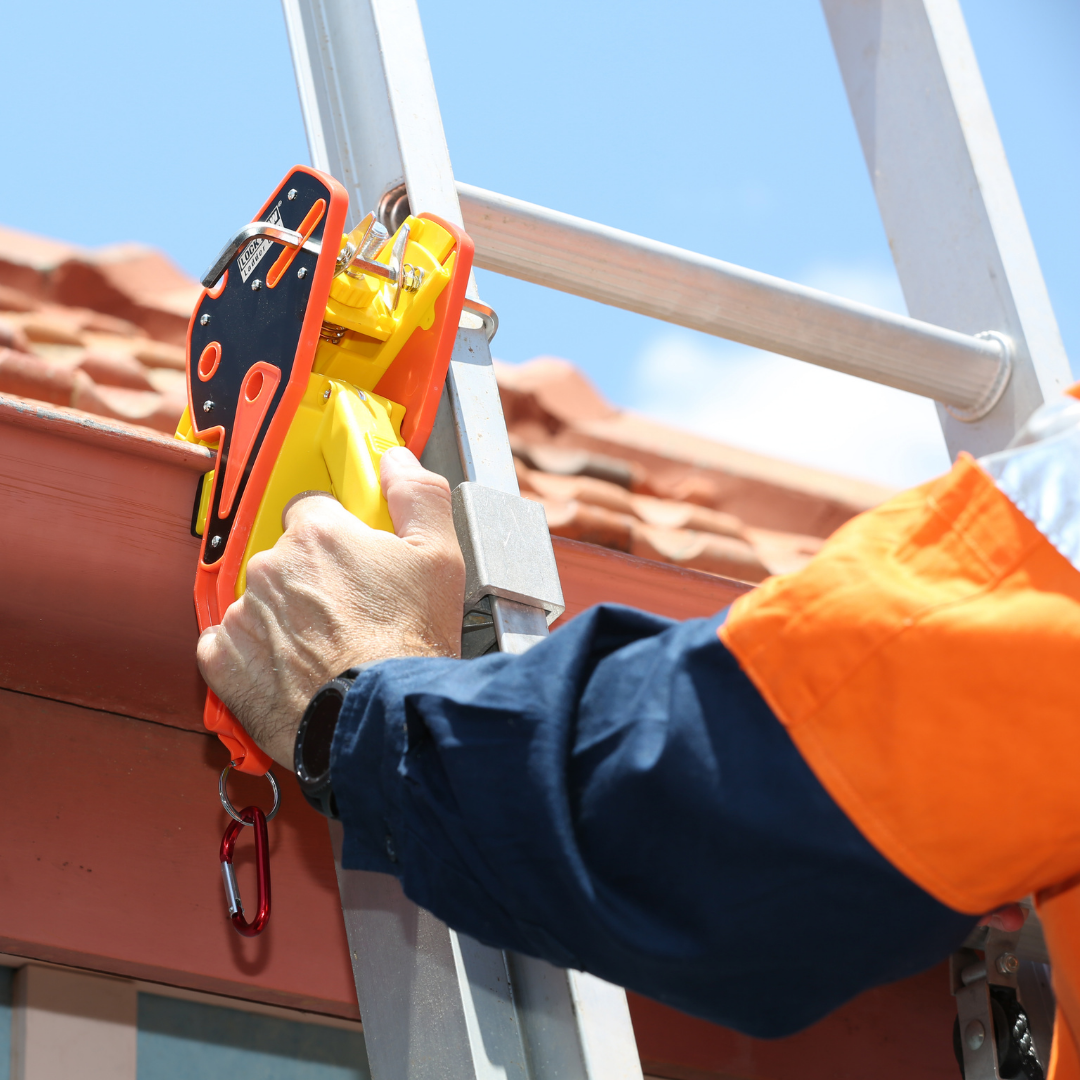
A gutter clamp holds the ladder rail to the gutter lip, which helps stop the top sliding sideways.
Lock Jaw Ladder Grip is one option:
- It works on most metal gutters with a lip.
- It has rubber pads that help protect the gutter and ladder.
- Use it only if the gutter is stable and you’re prepared to rest your ladder on it.

A gutter clamp fitted over the gutter lip and ladder rail
Tie to a Rigid Support
If there’s a solid anchor point near the top, such as a fixed eye bolt in the building structure, you can tie the ladder to it.
- Use a point that won’t bend or move. That rules out gutters, downpipes and gutter brackets.
- Tie both rails if you can, so the ladder can’t swing to either side.
- Check the tie before stepping on or off at the top.
This works best on buildings you access often, where an anchor point can be installed once and used many times.
Use a Standoff
A standoff attaches near the top of the ladder and rests on the roof or wall instead of the gutter.
- It keeps the ladder’s weight off the gutter, which suits gutter cleaning or delicate gutters.
- It works where a clamp can’t, such as vinyl gutters or no gutter at all.
- It spreads the ladder’s contact at the top, but it doesn’t clamp or tie the ladder to anything.
Secure the Base
Securing the top is only half the job. A ladder can also slide out at the bottom.

Top secured at the gutter, three points of contact on the way up
- Set up on stable, level ground. OSHA 1926.1053(b)(6): “Ladders shall be used only on stable and level surfaces unless secured to prevent accidental displacement.”
- Get the angle right. Set the base 1 foot out for every 4 feet of height.
- Extend it above the roof edge. OSHA 1926.1053(b)(1): the side rails “shall extend at least 3 feet (.9 m) above the upper landing surface,” or the ladder must be secured at the top if it can’t.
- Watch for slippery surfaces. OSHA 1926.1053(b)(7): “Ladders shall not be used on slippery surfaces unless secured or provided with slip-resistant feet to prevent accidental displacement.”
- Watch for traffic. Near doorways, driveways or walkways, secure the ladder or barricade the area so it can’t be knocked.
Source: OSHA ladder standard 1926.1053 (last amended April 2014, checked September 2026)
Working alone?
If there’s no one to hold the ladder, securing it becomes even more important:

Working solo with the ladder secured at the gutter
- Secure the top and the base before you climb.
- Keep three points of contact: two hands and one foot, or two feet and one hand.
- Carry only small items that still let you hold on. Use a tool belt or pouch rather than carrying things in your hands.
- Don’t lean or reach away from the ladder. Climb down and move it instead.
The Bottom Line
Ladders slide on gutters because the contact point is small and easily upset by wet surfaces, poor angles and over-reaching. Improvised ties rarely solve it.
The fix is to secure the ladder properly: clamp the gutter edge, tie to a rigid support, or use a standoff at the top, and secure the base at the bottom. Pick the option that suits your gutter and your job, and keep three points of contact the whole way.
FAQs
Why does my ladder slide on the gutter?
The gutter edge is narrow, often curved, and only the two rails touch it. Wet surfaces, the wrong angle, over-reaching and stepping on or off at the top can all make it shift.
Can I tie my ladder to the gutter?
It’s not recommended. Gutters and downpipes aren’t built as anchor points and may bend or pull away. Tie to a rigid support on the building structure instead.
Does someone holding the base stop the top sliding?
It helps keep the base steady, but the helper can’t do much about sideways movement at the top. Secure the top as well.
What angle should my ladder be at?
A common rule is 4 to 1: set the base 1 foot out for every 4 feet of height.
Will a gutter clamp work on my gutter?
Lock Jaw works on most metal gutters with a lip. Use it only if the gutter is stable and you’re prepared to rest your ladder on it. For vinyl gutters or no gutter, use a standoff or tie to a rigid support.
Do I need to secure the base as well as the top?
Yes. Securing the top won’t stop the base sliding out, so both need attention.
Related Reading
- Lock Jaw vs Ladder-Max: An Honest Comparison
- How to Stop a Ladder Slipping at the Roof Edge
- Lock Jaw for roofers
Working on metal gutters?