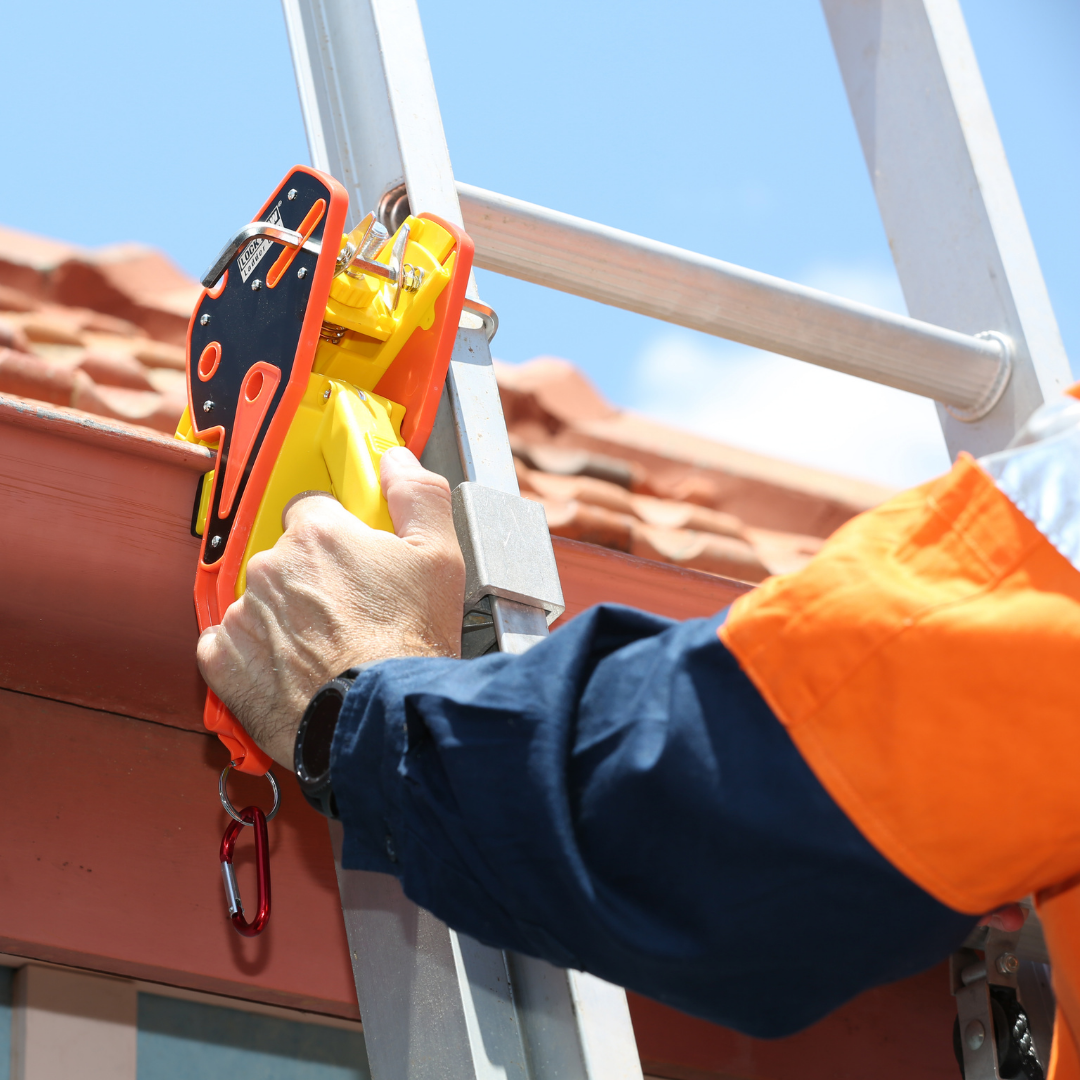
One fixed access point, or a device that moves with you from job to job?
Yes, there are permanent brackets for securing ladders. A fixed bracket or ladder dock is installed at one access point on a building, so the ladder can be tied or locked in place there every time. A portable clamp does a similar job but goes with you, and fits wherever there’s a suitable gutter.
The right choice depends on how often you use the same spot. A regular access point suits a fixed bracket. Work that moves from site to site suits a portable device.
Fixed Brackets and Docks
A fixed ladder bracket, sometimes called a ladder dock or tie-off point, is permanently installed on the building at the spot where a ladder is placed. The ladder is then tied, hooked or locked to it each time.
Where they suit
- One regular access point, such as the route onto a roof for routine maintenance, plant or inspections.
- Buildings you or your team visit often, where the same ladder position is used again and again.
- Places without a suitable gutter, where there’s nothing to clamp to.
Sound fixing
A bracket is only as secure as what it’s fixed to. For a permanent bracket:
- Fix it into the building structure, such as framing, masonry or a structural member, not into a gutter, gutter bracket or thin cladding.
- Follow the manufacturer’s installation instructions, including fixings and spacing, and have it installed by someone competent to do so.
- Mark the access point so everyone uses the bracket rather than leaning the ladder somewhere else.
Portable Clamps and Tie-Offs
Portable devices go with the ladder, so you can secure the top at different buildings without installing anything.
Gutter clamps
A gutter clamp holds the ladder rail to the gutter lip. Lock Jaw Ladder Grip is one example. It can be applied with one hand, locks on in seconds and comes off just as quickly, so it suits jobs where you move the ladder often or work across many sites. Only use it on a sound gutter; a plastic, loose or damaged gutter isn’t a support you can rely on.

Fitting a portable clamp at the gutter
Portable tie-offs
A strap or rope tie-off secures the ladder to a fixed point on the structure. It only works where there’s a solid point to tie to, and it needs to be checked each time it’s set up.
Fixed vs portable at a glance
| Fixed bracket or dock | Portable clamp | |
|---|---|---|
| Best for | One regular access point | Work that moves between jobs and sites |
| Installation | Permanently fixed to the building structure | None; fitted at the top each time |
| Needs | A sound structure to fix into | A sound gutter with a lip |
| Moves with you? | No | Yes |
| Setup at each visit | Tie or lock the ladder to the bracket | Fit the clamp to the gutter and ladder rail |
| Inspection | The bracket and its fixings, periodically and before use | The device and the gutter, each time |
Roof anchors are different
Don’t confuse a ladder bracket or clamp with a roof anchor. They do different jobs:
- A roof anchor is part of a fall arrest or restraint system. A harness and lanyard connect to it to stop or prevent a fall.
- A ladder bracket or ladder-top clamp secures the ladder so it can’t slip or move. It doesn’t protect you if you fall.
Don’t tie a ladder to a roof anchor unless the anchor’s manufacturer says it’s designed for that, and don’t clip a harness to a ladder bracket or clamp. Each must be used only for its designed purpose.
Cost and Inspection
Cost
- Fixed brackets: you pay for each bracket plus installation at each access point. The cost is spread over every visit to that spot, so it makes most sense where the same point is used often.
- Portable clamps: one device works across many buildings. Lock Jaw, for example, is $141 AUD per unit.
If you’re securing ladders at many different sites, a portable device is usually simpler. If you return to the same access point regularly, a fixed bracket can make each visit quicker.
Inspection
Both need regular checks:
- Fixed brackets: check for corrosion, cracks and loose or missing fixings. A bracket exposed to the weather can deteriorate between visits.
- Portable clamps: check the device for damage before each use, and check that the gutter is sound.
- The ladder itself: inspect it before every climb, whichever securing method you use.
“Inspect the ladder for damage before each use.” — SafeWork NSW
Source: SafeWork NSW: Ladders (last updated December 2025, checked September 2026)
What the Rules Say
SafeWork NSW doesn’t require a permanent bracket. It requires extension ladders to be secured, and to be used only where a ladder is the right tool:
“If you’re using an extension ladder, secure it at the top, bottom or both. If this isn’t possible then have someone hold the ladder in place while in use.” — SafeWork NSW
“Only use ladders for simple access jobs, or for a short duration. It’s best to work from ground level whenever possible.” — SafeWork NSW
So whether you use a fixed bracket or a portable device, what matters is that the ladder is secured. If ladder access is regular and frequent at one spot, SafeWork NSW also says to consider alternatives such as scaffolding or an elevated work platform.
Source: SafeWork NSW: Ladders (last updated December 2025, checked September 2026)
FAQs
Is there a permanent bracket for securing a ladder?
Yes. Fixed ladder brackets or docks are installed at one access point on a building, so the ladder can be secured there every time.
Should I choose a fixed bracket or a portable clamp?
A fixed bracket suits one regular access point. A portable clamp suits work that moves between jobs and sites.
Do the rules require a permanent bracket?
No. SafeWork NSW says to secure an extension ladder at the top, bottom or both. It doesn’t say the securing device must be permanent.
Can I tie my ladder to a roof anchor?
Only if the anchor’s manufacturer says it’s designed for that. Roof anchors are for fall arrest or restraint systems, not for securing ladders.
How often should a fixed bracket be inspected?
Check it before each use and periodically, especially if it’s exposed to the weather. Look for corrosion, cracks and loose fixings.
How quickly does a portable clamp go on and off?
Lock Jaw can be applied with one hand, locks on in seconds and comes off just as quickly.
Securing ladders at different sites?