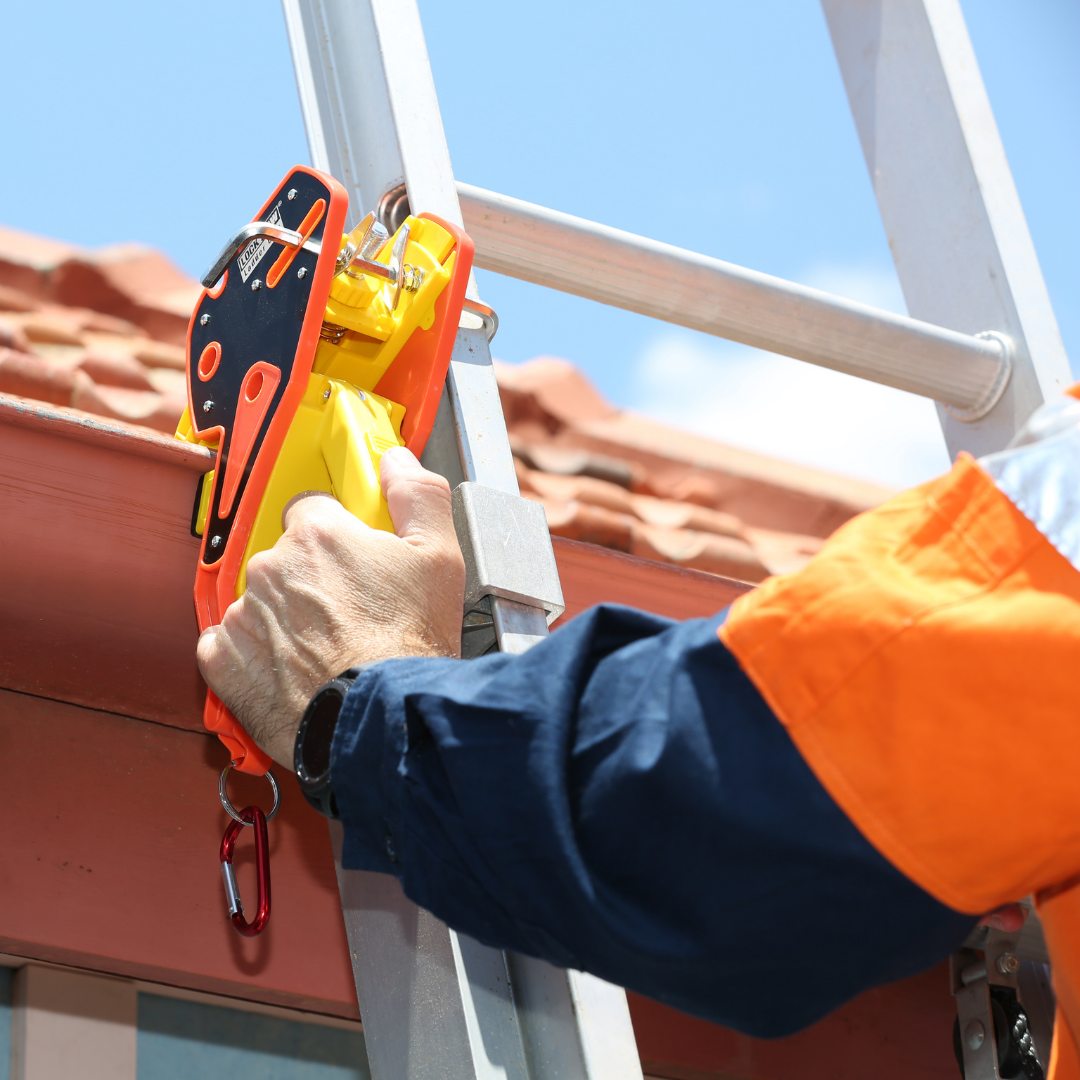
A ladder stabilizer is an accessory that makes an extension ladder less likely to slide, twist or kick out while you climb. There are three main types: a standoff, which holds the top of the ladder away from the wall or gutter; a gutter clamp, which locks the top of the ladder to the gutter lip; and a base leveler or spreader, which steadies the feet on uneven ground.
An extension ladder can move at the top, sliding or twisting along the gutter, or at the base, sliding out. The right stabilizer depends on which end is the problem and what the ladder is resting against. Below is what each type does, where each one does not work, and how they line up against OSHA's ladder rules.
The 3 Types of Ladder Stabilizer at a Glance
| Standoff stabilizer | Gutter clamp | Base leveler / spreader | |
|---|---|---|---|
| Where it works | Top of the ladder | Top of the ladder | Feet of the ladder |
| What it does | Holds the ladder top away from the wall, window or gutter, usually across a wider span | Locks the ladder rail to the gutter lip so the top can't slide sideways along the gutter | Levels the feet on sloped or uneven ground and widens the footprint |
| What the ladder rests on | The wall, or the roof surface on models rated for it | The gutter | The ground |
| Needs a gutter? | No | Yes, a sound metal gutter with a lip | No |
| Good for | Keeping weight off a weak, vinyl or guarded gutter; working at a wall or window | Climbing onto the roof at the gutter line; jobs where you move the ladder often and work alone | Sloped yards, steps, uneven pavers |
| Not good for | Narrow spots between windows or downspouts where the wide arms won't fit; it still doesn't lock the top in place | Plastic or vinyl gutters, loose or damaged gutters, fixed leaf guards, no gutter | Anything at the top of the ladder |
| Example | Ladder-Max Original, Werner AC78 | Lock Jaw Ladder Grip | Many brands of leg levelers |
The types solve different problems, so many crews carry more than one: a base leveler on almost every job, plus either a standoff or a gutter clamp at the top, depending on the gutter.
Standoff Stabilizers
A standoff is a U-shaped or wing-shaped arm that bolts or clips across the upper rungs of an extension ladder. Its tips rest on the wall or roof instead of the ladder rails.
What it does well:
- Keeps load off the gutter. The ladder rests on the wall or roof, so it suits vinyl gutters, damaged gutters and gutters with fixed leaf guards.
- Wider top contact. The span between the tips is wider than the ladder itself, which resists sideways tipping.
- Clearance. It lets you work on a gutter, window or eave without the ladder in the way.
Where it falls short:
- It doesn't lock the ladder to anything. A standoff makes the top wider and steadier, but the ladder can still be displaced if the base moves.
- Most attach on the ground before the ladder is raised, which makes the ladder top-heavy to raise and move.
- Check the rating before resting one on a roof. Ladder-Max, for example, states its Original model is "designed and certified for direct roof placement", with a 19-inch standoff, a 36-inch tip-to-tip span and a Type IAA rating of 375 lb (maker's page, checked November 2026). Not every standoff makes that claim.
For a brand-level comparison, see Lock Jaw vs Ladder-Max and Lock Jaw vs Werner AC78.
Gutter Clamps
A gutter clamp attaches at the top of the ladder after it is raised. Its jaws clamp under the lip of the gutter and a bar presses against the ladder rail, so the rail is held to the gutter instead of just leaning on it.

Placing Lock Jaw over the gutter edge and ladder rail
What it does well:
- Stops the top sliding along the gutter. This is the movement that a lean-to ladder on a wet, curved gutter lip is most prone to.
- Fast to fit and move. It goes on at the top, so there is nothing to bolt on before raising the ladder.
- Solo work. It secures the top without a second person holding the ladder.
Where it falls short:
- It needs a sound metal gutter with a lip the jaws can grip. No gutter, a plastic or vinyl gutter, a loose gutter or a fixed leaf guard all rule it out.
- The ladder rests on the gutter, so the gutter must be strong enough to rest a ladder on in the first place.
- It does not move the ladder away from the wall, so it gives no clearance for gutter-face work.
Lock Jaw Ladder Grip specs
Lock Jaw Ladder Grip is a gutter clamp. These are the published details from the product page, FAQs and instructions for use:
| Spec | Lock Jaw Ladder Grip |
|---|---|
| Type | Gutter-clamping ladder stabilizer (gutter mount) |
| How it attaches | Jaws clamp under the gutter lip; a bar locks against the side of the ladder rail |
| Fitting time | About 5 seconds, with one hand |
| Removal | Comes off in seconds |
| Ladder rails | Up to approximately 2 inches (50 mm) wide |
| Telescopic ladders | Some, not all: the bar must wind down firmly onto the rail |
| Gutters | Many metal profiles, including traditional and K-style, typically 4- to 6-inch; aluminum, steel or copper |
| Not for | Plastic or vinyl gutters, fixed metal leaf guards, gutters that are loose or damaged |
| Gutter protection | Rubber pads on the clamp |
| Carrying it up | Supplied carabiner clips to your belt so you keep three points of contact |
| One or two? | Designed as a single unit; two (one per side) give more stability for multi-story or frequent climbing |
| Materials | Glass-filled nylon and stainless steel |
| Standards | Meets the general requirements of ANSI-ASC A14.8-2013, the US ladder-accessory standard |
| Inspection | Check before and after each use; check-and-tag every 6 or 12 months depending on use |
| Warranty | 12-month warranty and 30-day money-back guarantee |
| Price (at time of writing) | $129 USD, free US shipping |

Locking Lock Jaw onto the gutter, one-handed
Lock Jaw was co-invented in Australia in 2009 by Craig Charlton and his father Robert Charlton after a ladder-related injury. It has 18+ industry awards and finalist recognitions, 17 years in the field, a 4.9 product review rating and more than 75,000 customers.
Base Levelers and Spreaders
A base leveler adjusts the length of each ladder leg so the feet sit level on a slope or step. A base spreader or stabilizer bar widens the footprint at the bottom.
They matter because a secure top doesn't help if the feet slide out. OSHA requires ladders to be used "only on stable and level surfaces unless secured to prevent accidental displacement" (1926.1053(b)(6)). A leveler gets you to level; tying off or staking the base deals with slippery or soft ground.
How to Choose: 5 Questions
- What is at the top of the ladder? A sound metal gutter with a lip: a gutter clamp works. Vinyl, plastic, damaged or guarded gutter, or no gutter: use a standoff, or tie off to a rigid point on the structure.
- Do you need to work on the gutter face or a window? A standoff gives clearance. A gutter clamp holds the ladder against the gutter.
- Are you climbing onto the roof? See the best ladder stabilizer for roof access for standoffs, roof hooks and gutter clamps side by side.
- Is the ground level? If not, add a base leveler, whatever you use at the top.
- Will you move the ladder a lot? Devices that go on at the top after the ladder is raised are quicker to move between placements than ones bolted on before raising.
Gutter cleaners have their own trade-offs, covered in what ladder stabilizer gutter cleaners use.
What OSHA Says About Securing an Extension Ladder
OSHA's construction ladder standard, 29 CFR 1926.1053, applies to employers. It doesn't require any particular stabilizer, but several rules decide how you set one up:
- Extend above the landing, or secure the top. (b)(1): side rails "shall extend at least 3 feet (.9 m) above the upper landing surface". If that isn't possible, the ladder "shall be secured at its top to a rigid support that will not deflect", with a grasping device such as a grab rail.
- Angle. (b)(5)(i): the base should be about one-quarter of the working length out from the top support, the 4-to-1 rule.
- Stable, level surfaces. (b)(6): ladders are used "only on stable and level surfaces unless secured to prevent accidental displacement."
- Slippery surfaces. (b)(7): not on slippery surfaces "unless secured or provided with slip-resistant feet", and slip-resistant feet are not a substitute for care in placing, lashing or holding the ladder.
- Both rails supported. (b)(10): the top of a non-self-supporting ladder is placed "with the two rails supported equally unless it is equipped with a single support attachment."
- Hands free. (b)(22): don't carry any object or load that could make you lose balance.
The general industry rule, 29 CFR 1910.23, has the same 3-foot extension (c)(11) and the same requirement to use ladders on stable, level surfaces unless "secured or stabilized" (c)(4). OSHA's portable ladder QuickCard summarizes the basics.
Ladder accessories in the US are covered by ANSI-ASC A14.8. A stabilizer is not fall protection, and no stabilizer makes an unsafe setup safe. For the full paragraph-by-paragraph rules, see US ladder rules for securing an extension ladder and Lock Jaw and OSHA.
FAQs
What does a ladder stabilizer do?
It steadies an extension ladder at the top or the base. A standoff widens the top and holds it off the wall, a gutter clamp locks the top to the gutter, and a base leveler keeps the feet level.
What is the best ladder stabilizer?
It depends on what the ladder rests against. On a sound metal gutter, a gutter clamp stops the top sliding and is quick to move. On vinyl gutters, guarded gutters or walls, a standoff is the better choice. On uneven ground, add a base leveler either way.
Is a ladder standoff the same as a stabilizer?
A standoff is one type of stabilizer. Many retailers call any top-mounted arm a "stabilizer", but it is the standoff design that holds the ladder away from the wall.
Can I use a gutter clamp on vinyl gutters?
Lock Jaw is not designed for plastic or vinyl gutters. Use a standoff, or tie off to a rigid support on the building structure.
Does OSHA require a ladder stabilizer?
No specific device is required. OSHA requires ladders to be used on stable, level surfaces unless secured to prevent displacement, and to extend 3 feet above the landing or be secured at the top. A stabilizer is one way to meet the securing part.
Do I need one or two gutter clamps?
Lock Jaw is designed to work as a single unit. People who access multi-story buildings or climb often tend to use two, one on each side, for more stability.
Will a gutter clamp damage my gutter?
Lock Jaw has rubber pads to help prevent scratching and is designed not to damage a suitable, sound gutter when used correctly. Only use it on a gutter you would be prepared to rest a ladder on.