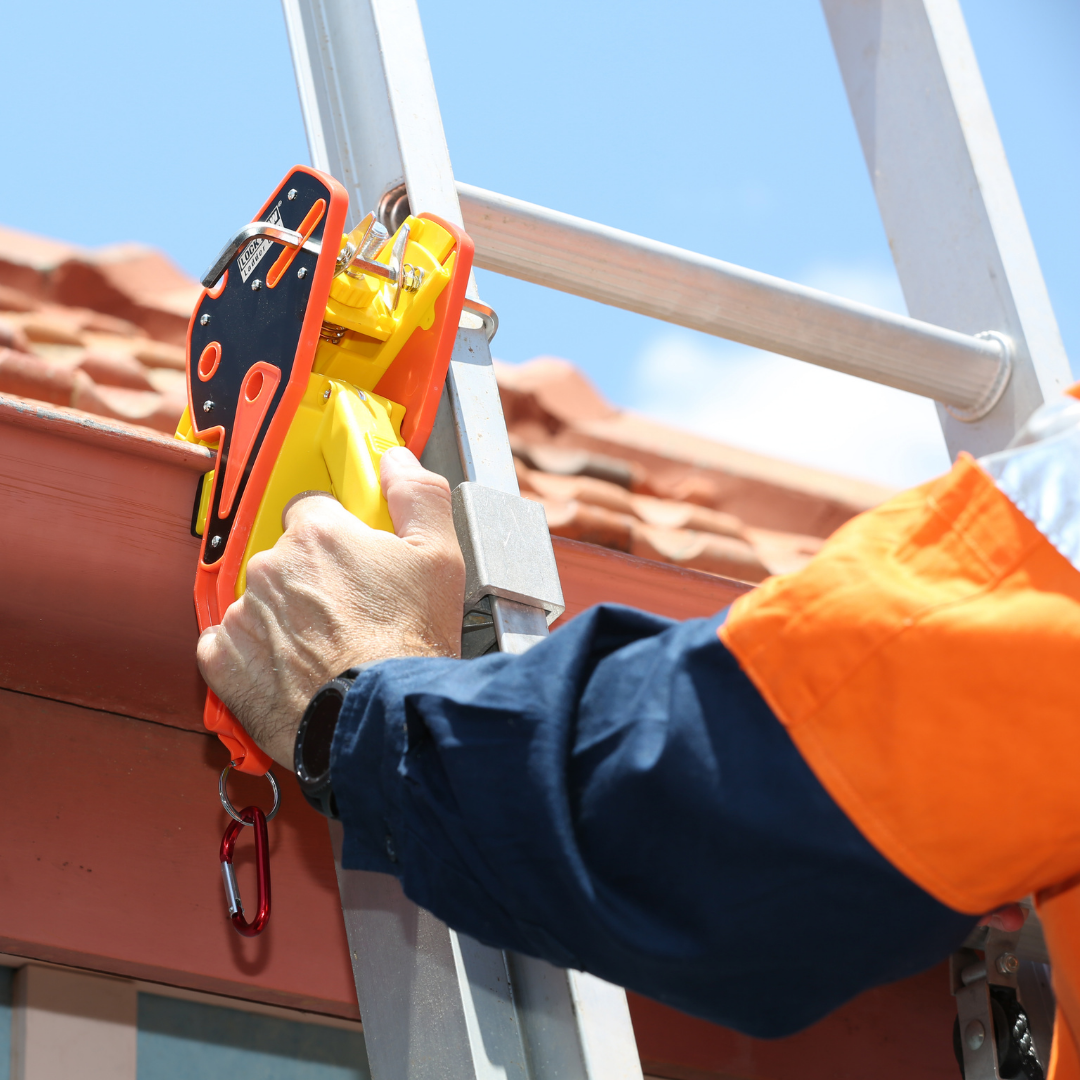
Gutter cleaners move their ladder more than almost any other trade. Here’s how to choose and set up a stabilizer that keeps up.
Most gutter cleaners use one of two stabilizers: a standoff, which holds the ladder off the gutter, or a gutter clamp, which locks the ladder to the gutter lip. The right one depends on your gutters, any leaf guards, and how often you move the ladder.
Gutter cleaning means dozens of ladder moves a day, often on gutters full of wet leaves. The stabilizer you choose affects how quickly you can set up, how well the ladder stays put, and whether the gutter survives the job.
Below, we compare the two and look at how to choose.
Standoff or Gutter Clamp
Both sit at the top of the ladder, but they work in opposite ways:
| Standoff | Gutter clamp | |
|---|---|---|
| How it works | Holds the ladder away from the gutter, resting on the roof or wall | Holds the ladder rail to the gutter lip |
| Weight on the gutter | None; the ladder rests on the roof or wall | The ladder rests on the gutter |
| Reaching into the gutter | The gap lets you reach the gutter in front of the ladder | The ladder sits at the gutter, so you work beside it |
| Moving the ladder | Stays on the ladder between moves | Unclip, move, and re-apply at each spot |
| Needs | A roof or wall surface to rest on | A sound gutter with a lip |
Neither is right for every job. The best choice depends on the gutter, the roof and how you work.
What Cleaners Need
Gutter cleaning puts different demands on a stabilizer than roof access does. Cleaners typically need:
- Fast setup. You may move the ladder every few feet, so every extra minute at each spot adds up.
- Stability while you work. You’re scooping, pulling debris and handling a bucket, so the ladder needs to stay put.
- Protection for the gutter. Customers notice dents and scratches.
- Something that fits the gutters in your area. A tool that doesn’t fit a common gutter type is a tool you can’t use.
And through all of it, the ladder basics still apply: keep your body between the rails, and move the ladder rather than reaching.
Protecting the Gutter
A loaded ladder can dent or bend a gutter, especially an older or thinner one. There are two ways to reduce that risk:
- Keep the weight off the gutter with a standoff, so the ladder rests on the roof or wall instead.
- Spread and cushion the contact with a gutter clamp. On Lock Jaw Ladder Grip, rubber pads help protect the gutter.

A gutter clamp fitted to a K-style gutter
Whichever you use, check the gutter first. If it’s loose, damaged or pulling away from the fascia, don’t rest a ladder on it.
Gutter and Leaf-Guard Fit
Fit is where many cleaners get caught out, so check it before you buy.
Gutter clamps
Lock Jaw Ladder Grip is one gutter clamp option:
- It fits K-style gutters with adjustments and most gutters with a lip.
- It can be applied with one hand and locks on in seconds.
- Fixed metal leaf guards prevent fitting.

A gutter clamp on a K-style gutter

A gutter clamp on a box gutter
Half-round gutters
Don’t assume a gutter clamp will fit a half-round gutter. Their rounded shape is different from K-style and box gutters, so check with the manufacturer before relying on a clamp for half-round gutters.
Standoffs
A standoff doesn’t touch the gutter, so the gutter shape and any leaf guards don’t affect it. It does need a firm roof or wall surface for its arms to rest on.
Securing the Ladder
OSHA’s ladder standard (1926.1053) calls for ladders to be secured where they could be displaced.
At the top
- Use your standoff or gutter clamp every time you move the ladder, not just for the first set-up.
- Extend the ladder above the gutter if you’ll step onto the roof. OSHA 1926.1053(b)(1): the side rails “shall extend at least 3 feet (.9 m) above the upper landing surface,” or the ladder must be secured at the top if it can’t.
Source: OSHA ladder standard 1926.1053 (last amended April 2014, checked September 2026)

Climbing to a ladder secured at the gutter
At the base
Gutter cleaners often set up on uneven ground: garden beds, sloping lawns, paths and steps. This is where base levelers help.
- What they are: adjustable leg extensions fitted to the bottom of the ladder. Each side can be set to a different length.
- What they do: keep the ladder level when one foot is on higher ground than the other, instead of propping it up with bricks or timber.
- When to use them: any time the ground isn’t flat. OSHA 1926.1053(b)(6): “Ladders shall be used only on stable and level surfaces unless secured to prevent accidental displacement.”
- Set the angle: 1 foot out for every 4 feet of height.
- On slippery surfaces, such as wet grass or paving, follow OSHA 1926.1053(b)(7): “Ladders shall not be used on slippery surfaces unless secured or provided with slip-resistant feet to prevent accidental displacement.”
- Keep three points of contact as you climb. OSHA 1926.1053(b)(22): “An employee shall not carry any object or load that could cause the employee to lose balance and fall.” Use a bucket hook or tool belt instead.
Source: OSHA ladder standard 1926.1053 (last amended April 2014, checked September 2026)
More for cleaners: Lock Jaw for gutter cleaners
The Bottom Line
Gutter cleaners use both standoffs and gutter clamps. A standoff keeps weight off the gutter and works with any gutter shape. A gutter clamp holds the ladder to the gutter and goes on quickly at each move.
Check your gutters and leaf guards, level the base, and secure the ladder every time you move it.
FAQs
What ladder stabilizer do gutter cleaners use?
Most use either a standoff, which rests on the roof or wall and keeps weight off the gutter, or a gutter clamp, which holds the ladder rail to the gutter lip.
Is a standoff or a gutter clamp better for gutter cleaning?
Neither is right for every job. A standoff suits gutters you can’t rest a ladder on. A gutter clamp suits sound gutters with a lip and goes on quickly at each move.
Will a gutter clamp fit my gutters?
Lock Jaw fits K-style gutters with adjustments and most gutters with a lip. Don’t assume a clamp fits a half-round gutter. Check with the manufacturer first.
Can I use a gutter clamp with leaf guards?
Fixed metal leaf guards prevent Lock Jaw from fitting. A standoff doesn’t touch the gutter, so leaf guards don’t affect it.
What are base levelers?
Adjustable leg extensions on the bottom of the ladder. They keep it level on uneven ground, such as sloping lawns, garden beds or steps.
Will a ladder damage my customer’s gutter?
It can, especially an older or thinner gutter. Use a standoff to keep the weight off it, or a clamp such as Lock Jaw, whose rubber pads help protect the gutter. Don’t rest a ladder on a loose or damaged gutter.
Related Reading
- Lock Jaw vs Ladder-Max: An Honest Comparison
- Why Ladders Slide on Gutters (and How to Stop Them)
- How to Stop a Ladder Slipping at the Roof Edge
- Lock Jaw for gutter cleaners
Cleaning K-style or lipped gutters?