How to keep a ladder steady on a two-story exterior.
To keep a ladder steady on a two-story exterior, level the base, secure the top at the eave, extend the ladder enough to hold on, and move it often instead of reaching sideways. Painting means long stretches on the ladder with a brush or roller in one hand, so the setup has to stay put without you noticing it.
Where Painters’ Ladders Move
A painter’s ladder is usually at work for longer than most trades, and it tends to move in the same places:
- At the top, sideways. Reaching for the next section of fascia or weatherboard pushes the top along the gutter or wall.
- At the base. Garden beds, sloping paths and drop sheets give the feet a poor footing, and drop sheets can slide on smooth paving.
- In the middle. On a two-story job the ladder is long, so it flexes more, especially if the angle is wrong.
- When you climb down and back up with paint, tools or a different brush.
“Use a ladder only on a stable and level surface, unless it has been secured (top or bottom) to prevent displacement.” — OSHA Portable Ladder Safety QuickCard
Source: OSHA Portable Ladder Safety QuickCard (publication OSHA 3246, checked September 2026)
Securing at Eaves
At the eave, the top of the ladder usually rests on either the gutter or the fascia. Each needs a different approach.
| Top rests on | How to secure it | Keep in mind |
|---|---|---|
| A sound metal gutter | A gutter clamp holding the ladder rail to the gutter lip | Only if the gutter is stable enough to take the ladder |
| A vinyl, loose or damaged gutter | Tie to a rigid support on the structure, or use a standoff | Don’t rest the ladder on the gutter |
| The fascia or wall (no gutter) | Tie to a rigid support, or use a standoff to hold the ladder off the surface | A standoff also keeps the ladder off fresh paint |
Gutter setups
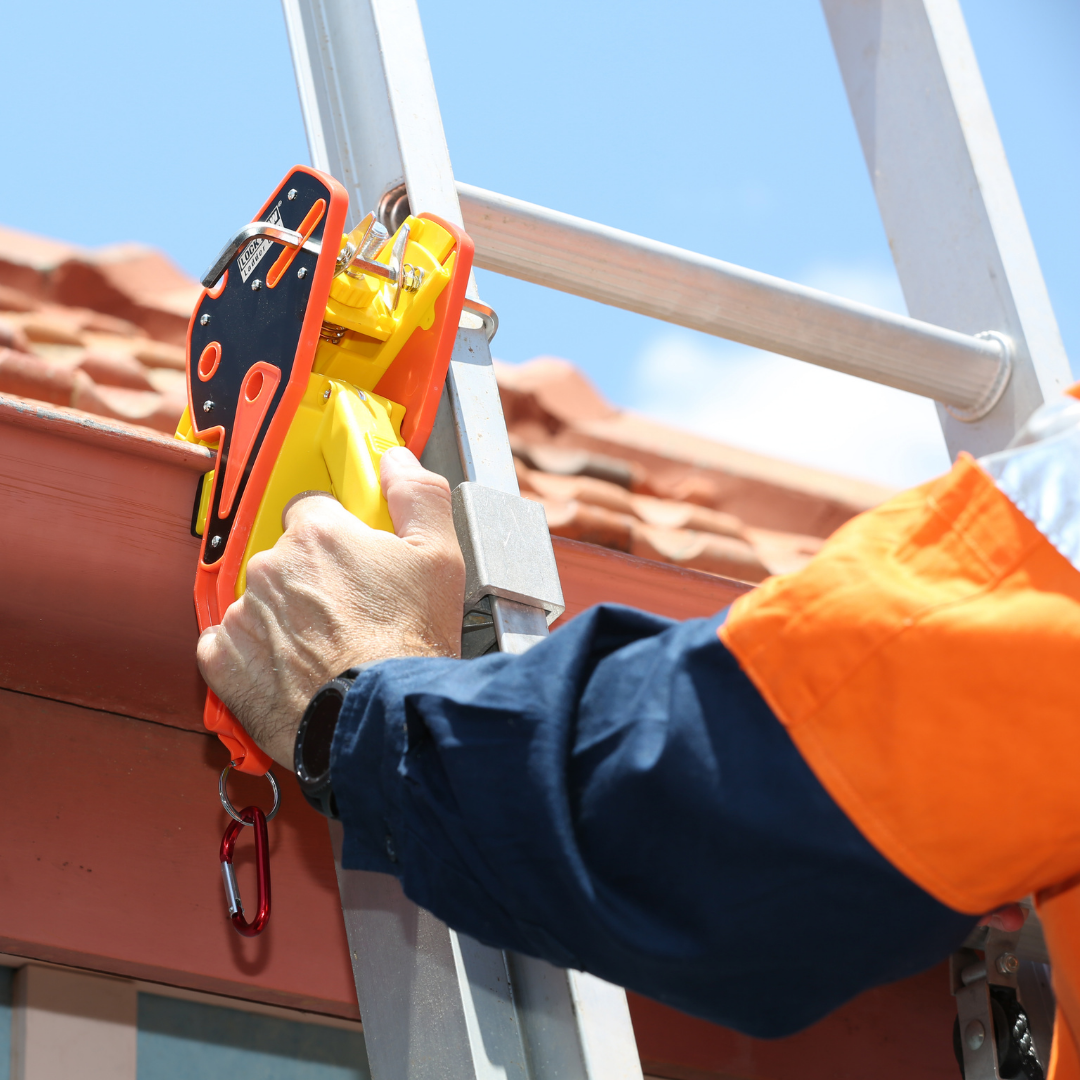
Lock Jaw Ladder Grip is one gutter clamp option. It locks on in seconds and comes off just as quickly, which suits painters who move the ladder along the house all day. Use it only if the gutter is stable and you are prepared to rest a ladder on it.

A gutter clamp holding the ladder to a K-style gutter
Fascia setups
If you’re painting the fascia or gutter itself, the ladder and any clamp will be in the way of the section you’re working on. Work in sections: paint either side of the ladder, then move it and come back to the gap once the paint is dry. Where there’s no gutter, secure the ladder to a rigid support or use a standoff rather than leaning it on the fascia.
Level base and the right extension
- Level the base on firm ground. Use leg levelers on sloping ground rather than bricks or timber, and keep drop sheets out from under the feet.
- Set the angle: OSHA’s QuickCard says to place the base “a quarter of the working length of the ladder from the wall,” about 1 foot out for every 4 feet up.
- Extend above the eave if you’re stepping onto the roof, and stay off the top rungs while you paint.
“An extension or straight ladder used to access an elevated surface must extend at least 3 feet above the point of support (see diagram). Do not stand on the three top rungs of a straight, single or extension ladder.” — OSHA Portable Ladder Safety QuickCard
Source: OSHA Portable Ladder Safety QuickCard (publication OSHA 3246, checked September 2026)
Avoiding Over-Reaching
Over-reaching is the habit that moves ladders on painting jobs. One more stroke to the side shifts your weight off the centre of the ladder and pushes the top sideways.
“Always maintain a 3-point (two hands and a foot, or two feet and a hand) contact on the ladder when climbing. Keep your body near the middle of the step and always face the ladder while climbing.” — OSHA Portable Ladder Safety QuickCard
- Keep your body between the rails. If your belt buckle goes past a rail, you’re reaching too far.
- Paint the width you can reach comfortably, then move the ladder.
- Use an extension pole for the roller rather than stretching out from the ladder.
- Keep three points of contact. Hang the paint tin from a hook on the ladder rather than holding it.
Source: OSHA Portable Ladder Safety QuickCard (publication OSHA 3246, checked September 2026)
Moving the Ladder
Moving the ladder often is what stops you reaching. Make it routine:
- Climb all the way down before moving it. Never “walk” or shuffle the ladder while you’re on it.
- Release the top first, then lower or carry the ladder to the next spot.
- Reset the base and angle at every new position. The ground changes as you go around the house.
- Secure the top again before climbing. A clamp that comes off quickly and locks on in seconds keeps this from slowing the job down.
- Look up for overhead lines every time you raise the ladder, not just at the start of the job.
“Do not move or shift a ladder while a person or equipment is on the ladder.” — OSHA Portable Ladder Safety QuickCard
“Avoid electrical hazards! – Look for overhead power lines before handling a ladder.” — OSHA Portable Ladder Safety QuickCard
Source: OSHA Portable Ladder Safety QuickCard (publication OSHA 3246, checked September 2026)
Regulator Guidance
OSHA’s Portable Ladder Safety QuickCard sums up the points that matter most for painters:
| Topic | OSHA QuickCard guidance |
|---|---|
| Base | Use a ladder only on a stable and level surface, unless it has been secured (top or bottom) |
| Angle | Place the base a quarter of the working length of the ladder from the wall |
| Extension | At least 3 feet above the point of support when accessing an elevated surface; don’t stand on the top three rungs |
| Body position | Keep your body near the middle of the step and face the ladder |
| Moving | Don’t move or shift a ladder while a person or equipment is on it |
| Accessories | Only use ladders and appropriate accessories (ladder levelers, jacks or hooks) for their designed purposes |
| Load | Don’t exceed the load rating, including the weight of tools or equipment |
Source: OSHA Portable Ladder Safety QuickCard (publication OSHA 3246, checked September 2026)
FAQs
How do painters stop a ladder sliding along the gutter?
Secure the top with a gutter clamp on a sound gutter, or tie it to a rigid support, and move the ladder rather than reaching sideways.
What if there’s no gutter, only fascia?
Tie the ladder to a rigid support on the structure, or use a standoff to hold it off the surface. Don’t rely on the ladder resting against the fascia alone.
How far can I reach from a ladder?
Keep your body near the middle of the step, as OSHA’s QuickCard says. If you need to reach further, climb down and move the ladder.
How far should the ladder extend above the eave?
If you’re using the ladder to access the roof, OSHA’s QuickCard says at least 3 feet above the point of support. Don’t stand on the top three rungs while painting.
Can I move the ladder while I’m on it?
No. OSHA’s QuickCard says not to move or shift a ladder while a person or equipment is on it.
Can I use a gutter clamp on any gutter?
No. Use it only if the gutter is stable and you are prepared to rest a ladder on it.
Related Reading
Moving the ladder along the house all day?