No one to hold the ladder? Here’s how to set it up so you don’t need them.
When you work alone, the ladder has to be secure without anyone holding it. Level the base on firm ground, set the right angle, secure the top before you rely on the ladder, check it before you climb, and make sure someone knows where you are. Here’s how, using OSHA’s Portable Ladder Safety QuickCard.
What Rules Say About a Second Person
OSHA’s Portable Ladder Safety QuickCard doesn’t offer a second person as a way to stabilize a ladder. It says to secure the ladder instead:
“Use a ladder only on a stable and level surface, unless it has been secured (top or bottom) to prevent displacement.” — OSHA Portable Ladder Safety QuickCard
“A ladder placed in any location where it can be displaced by other work activities must be secured to prevent displacement or a barricade must be erected to keep traffic away from the ladder.” — OSHA Portable Ladder Safety QuickCard
For a solo worker, that leaves one practical option: secure the ladder itself. A second person isn’t part of the plan, so the setup has to work without one.
Source: OSHA Portable Ladder Safety QuickCard (publication OSHA 3246, checked September 2026)
Level the Base
A secure top won’t help if the base can slide or rock. On your own, there’s no one to notice it moving, so get the base right before anything else.
“Do not place a ladder on boxes, barrels or other unstable bases to obtain additional height.” — OSHA Portable Ladder Safety QuickCard
- Find firm, level ground. Soft soil, gravel and sloping paths can let the feet sink or slide.
- Use leg levelers on uneven ground rather than propping a foot on bricks or timber.
- Set the angle: OSHA’s QuickCard says to place the base “a quarter of the working length of the ladder from the wall or other vertical surface.” That’s about 1 foot out for every 4 feet up.
- Keep traffic away. Near doors, driveways or paths, barricade the area so nothing can knock the ladder while you’re up there.
Source: OSHA Portable Ladder Safety QuickCard (publication OSHA 3246, checked September 2026)
Secure the Top
The top of the ladder is where most solo setups go wrong. You need to secure it, but you also need both hands for the climb.
Carry the device up, then fit it at the top
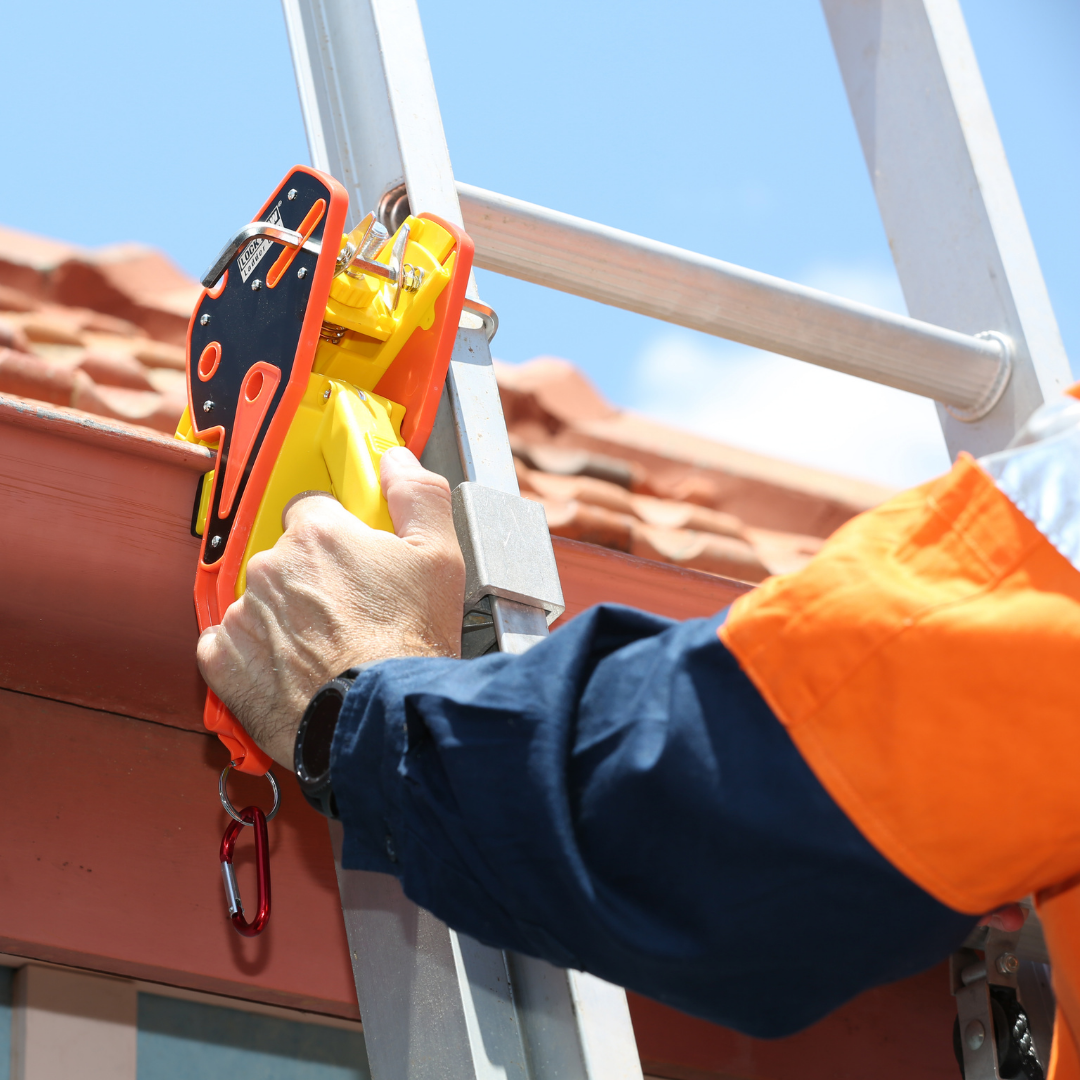
Lock Jaw Ladder Grip is designed for this. It clips to a belt loop, so three points of contact are kept while climbing. At the top, it can be applied with one hand using the supplied carabiner, while your other hand holds the ladder.

Clipped on with the supplied carabiner, leaving both hands free for the climb

Fitting the clamp to the gutter one-handed, with the other hand on the ladder
Only use a gutter clamp on a sound gutter that can take the ladder’s weight. If the gutter is vinyl, loose or damaged, or there’s no gutter, tie the ladder to a rigid support on the building instead.
Extend above the landing
OSHA’s QuickCard says an extension or straight ladder used to reach an elevated surface “must extend at least 3 feet above the point of support,” and not to stand on the top three rungs. The extra length gives you something to hold as you step on and off.
Check Before Climbing
When you’re alone, there’s no second set of eyes. Run through a quick check every time:
| Check | What to look for |
|---|---|
| The ladder | Damage to rails, rungs or feet. OSHA: if the ladder is damaged, remove it from service and tag it |
| Labels and rating | Read and follow all labels. Your weight plus tools must stay under the load rating |
| Locks and feet | All locks on an extension ladder properly engaged; rungs and feet free of slippery material |
| Overhead lines | Look for overhead power lines before handling the ladder |
| The base | Firm, level ground at the right angle, with nothing that could knock the ladder |
| The top | Secured to a sound gutter or rigid support, and extended above the landing |
| You | Physically able to do the climb, with hands free and your phone on you |
“Always inspect the ladder prior to using it. If the ladder is damaged, it must be removed from service and tagged until repaired or discarded.” — OSHA Portable Ladder Safety QuickCard
“Avoid electrical hazards! – Look for overhead power lines before handling a ladder.” — OSHA Portable Ladder Safety QuickCard
Source: OSHA Portable Ladder Safety QuickCard (publication OSHA 3246, checked September 2026)
Plan for Solo Work
A fall is more serious when no one is around to help. Plan for that before you start:
- Keep your phone on you, charged and in a zipped pocket, not in the vehicle. Don’t use it while you’re climbing; keep three points of contact.
- Tell someone where you are and when you expect to finish, and agree when you’ll check in.
- Check the weather. Wind and rain make the ladder and roof harder to work on safely.
- Keep the job short and simple. Plan the job so you’re not carrying heavy loads up the ladder or working at the top for long periods.
- Know when not to work alone. If the ladder can’t be secured at the top or the base, the task needs heavy materials, or it will take a long time, use another method or bring help.
FAQs
Can I use a ladder on my own?
Yes, as long as the ladder is secured and the job suits a ladder. Level the base, secure the top, check the ladder before you climb, and keep three points of contact.
What if no one can hold the ladder?
Then the ladder must be secured. OSHA’s QuickCard says to use a ladder only on a stable and level surface unless it’s secured (top or bottom) to prevent displacement.
How do I carry a gutter clamp up the ladder?
Lock Jaw clips to a belt loop with its supplied carabiner, so three points of contact are kept while climbing.
What should I check before climbing alone?
The ladder for damage, its load rating, the locks and feet, overhead power lines, the base, the top, and that you have your phone on you.
What if the top can’t be secured?
Don’t rely on the ladder alone. Tie it to a rigid support on the building, or use another method such as a platform or scaffold. A gutter clamp only suits a sound gutter.
Related Reading
Working alone at the gutter?