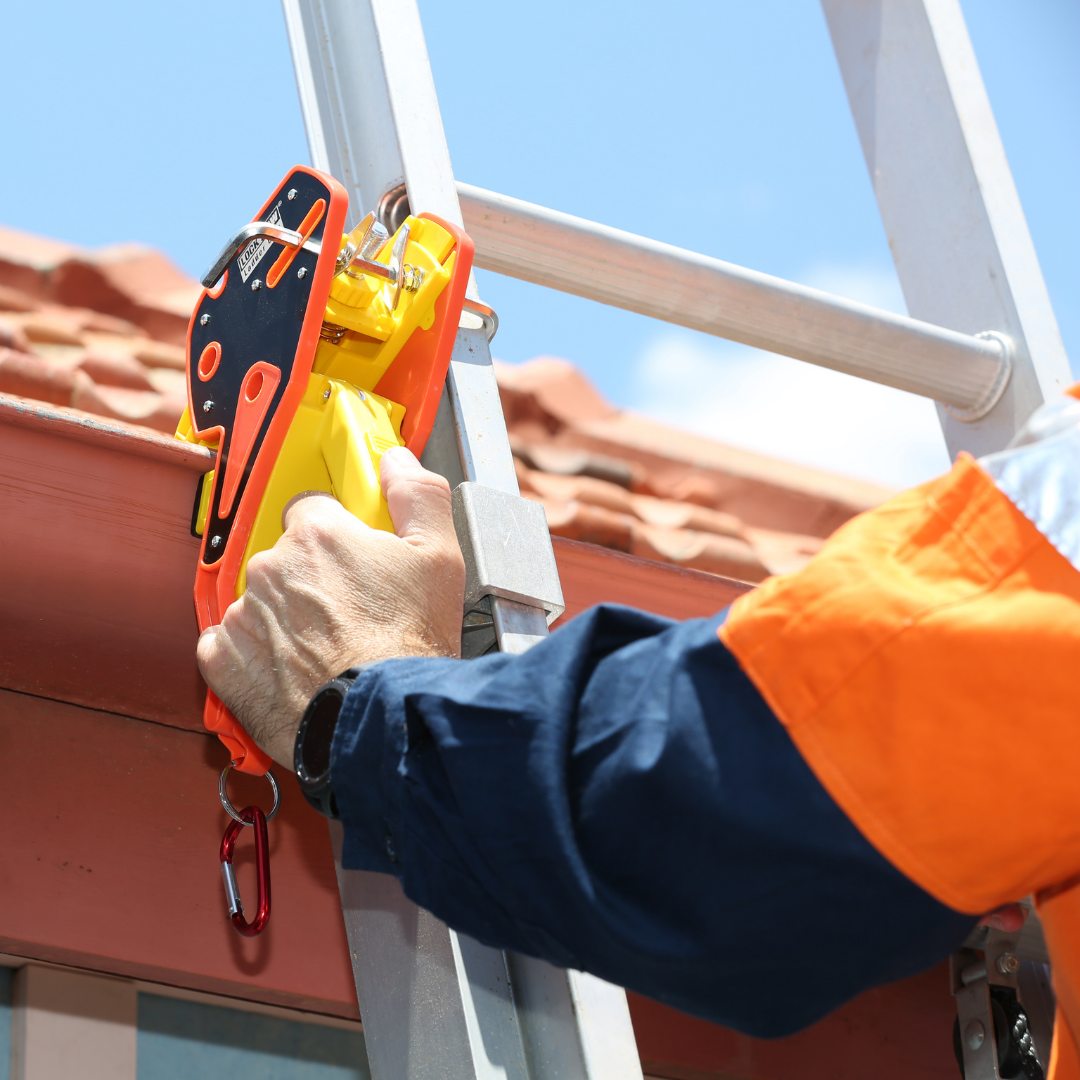
A ladder stabiliser is an accessory that makes an extension ladder less likely to slide, twist or kick out while you climb. There are three main types: a stand-off, which holds the top of the ladder away from the wall or gutter; a gutter clamp, which locks the top of the ladder to the gutter lip; and a leveller or base stabiliser, which steadies the feet on uneven ground.
An extension ladder can move at the top, sliding along the gutter, or at the feet, sliding out. The right stabiliser depends on which end is the problem and what the ladder rests against. Below is what each type does, where each one doesn't work, and what Australian work health and safety guidance expects.
The 3 Types of Ladder Stabiliser at a Glance
| Stand-off stabiliser | Gutter clamp | Leveller / base stabiliser | |
|---|---|---|---|
| Where it works | Top of the ladder | Top of the ladder | Feet of the ladder |
| What it does | Holds the ladder top away from the wall, window or gutter, across a wider span | Locks the ladder stile to the gutter lip so the top can't slide along the gutter | Levels the feet on sloping or uneven ground and widens the footprint |
| What the ladder rests on | The wall, or the roof on models rated for it | The gutter | The ground |
| Needs a gutter? | No | Yes, a sound metal gutter with a lip | No |
| Good for | Keeping weight off a weak, plastic or guarded gutter; wall and window work | Getting on and off the roof at the gutter line; moving the ladder often; working alone | Sloping yards, steps, uneven pavers |
| Not good for | Tight spots where the wide arms won't fit; it doesn't lock the top in place | Plastic or vinyl gutters, loose or damaged gutters, fixed leaf guards, no gutter | Anything at the top of the ladder |
Many tradies carry more than one: a leveller for uneven ground, plus a stand-off or a gutter clamp at the top, depending on the gutter.
Stand-Off Stabilisers
A stand-off is a U-shaped or wing-shaped arm fitted across the upper rungs of an extension ladder. Its tips rest on the wall or roof instead of the ladder stiles.
- It keeps load off the gutter, so it suits plastic gutters, damaged gutters and gutters under fixed leaf guards.
- It widens the top contact, which resists sideways tipping.
- It gives clearance for gutter-face, window and eave work.
The limits: a stand-off doesn't lock the ladder to anything, most are fitted on the ground before the ladder is raised, and not every model is designed to rest on a roof. Check the maker's rating before you put one on roof sheeting or tiles.
For brand comparisons, see Lock Jaw vs Ladder-Max and Lock Jaw vs Werner AC78.
Gutter Clamps
A gutter clamp goes on at the top after the ladder is raised. Its jaws clamp under the gutter lip and a bar presses against the ladder stile, so the stile is held to the gutter instead of just leaning on it.

Placing Lock Jaw over the gutter edge and ladder rail
- It stops the top sliding along the gutter, the movement a ladder on a wet, curved lip is most prone to.
- It's quick to fit and move, with nothing to fit before raising the ladder.
- It helps when you work alone, securing the top without someone holding the ladder.
The limits: it needs a sound metal gutter with a lip, it doesn't work on plastic or vinyl gutters or under fixed leaf guards, and it gives no clearance from the gutter.
Lock Jaw Ladder Grip specs
Lock Jaw Ladder Grip is a gutter clamp, invented in Australia. From the product page, FAQs and instructions for use:
| Spec | Lock Jaw Ladder Grip |
|---|---|
| Type | Gutter-clamping ladder stabiliser (gutter mount) |
| How it attaches | Jaws clamp under the gutter lip; a bar locks against the side of the ladder stile |
| Fitting time | About 5 seconds, with one hand |
| Removal | Comes off in seconds |
| Ladder stiles | Up to approximately 50 mm wide |
| Telescopic ladders | Some, not all: the bar must wind down firmly onto the stile |
| Gutters | Many metal profiles, including traditional and K-style, typically 4- to 6-inch (about 100 to 150 mm); aluminium, steel or copper |
| Not for | Plastic or vinyl gutters, fixed metal leaf guards, loose or damaged gutters |
| Gutter protection | Rubber pads on the clamp |
| Carrying it up | Supplied carabiner clips to your belt so you keep three points of contact |
| One or two? | Designed as a single unit; two (one per side) give more stability for multi-storey or frequent climbing |
| Materials | Glass-filled nylon and stainless steel |
| Inspection | Check before and after each use; check-and-tag every 6 or 12 months depending on use |
| Warranty | 12-month warranty and 30-day money-back guarantee |
| Price (at time of writing) | $141 AUD |

Locking Lock Jaw onto the gutter, one-handed
Lock Jaw was co-invented in Australia in 2009 by Craig Charlton and his father Robert Charlton after a ladder-related injury. It has 18+ industry awards and finalist recognitions, 17 years in the field, a 4.9 product review rating and more than 75,000 customers.
Levellers and Base Stabilisers
A leveller adjusts each leg so the feet sit level on a slope or step; a base stabiliser widens the footprint. They matter because a secure top doesn't help if the feet slide out. SafeWork NSW says to set up on a flat, stable surface, and where that isn't possible, to use a ladder with safety devices such as leg levellers and stabilisers.
Roof Access: Stabilisers, Ladder Arms and Roof Hooks
For getting onto a roof, three different things get called a "roof stabiliser":
- A gutter clamp secures the extension ladder at the eave, where you step on and off. Use it on a sound metal gutter.
- A roof-rated stand-off or ladder arms rest on the roof and keep weight off the gutter. Use them on plastic or damaged gutters, or where there's no gutter. More in ladder arms for roof work.
- A roof hook (ridge hook) clips to the top rungs of a straight ladder and hooks over the ridge so the ladder lies on the roof as a roof ladder. It's for working on the slope, not for securing the ladder you climb to reach the eave.
Whichever you use, extend the ladder about 1 metre above the step-off point and keep three points of contact as you step on and off. See how to stop a ladder slipping at the roof edge and safe roof access tips.
How to Choose: 5 Questions
- What's at the top of the ladder? A sound metal gutter with a lip: a gutter clamp works. Plastic, damaged or guarded gutter, or no gutter: use a stand-off or ladder arms, or secure to a rigid point on the structure.
- Do you need to work on the gutter face or a window? A stand-off gives clearance; a gutter clamp doesn't.
- Are you getting onto the roof? Secure the top at the eave and extend 1 metre above the step-off point. Add a roof hook only if you'll work on the slope.
- Is the ground level? If not, add a leveller.
- Will you move the ladder a lot? Devices fitted at the top after raising are quicker to move.
Gutter cleaners have their own trade-offs: what ladder stabiliser do gutter cleaners use?
What Australian WHS Guidance Says
In Australian workplaces, ladder work falls under the Work Health and Safety Regulations (Part 4.4, Falls) and the model Code of Practice Managing the risk of falls at workplaces. The Code treats single and extension ladders as a last resort, used only where safer options such as scaffolding or an elevating work platform are not reasonably practicable. State regulators' ladder guidance says the same things about setup:
- Secure the ladder. SafeWork NSW: "If you're using an extension ladder, secure it at the top, bottom or both." WorkSafe Victoria: straight and extension ladders should be "secured at the top and bottom."
- Extend above the step-off point. WorkSafe Victoria: "3 rungs above the step-off point or it extends 1m when used for access."
- Use the 4:1 angle. SafeWork NSW: "position the base of the ladder 1 metre away from the structure for every 4 metres of height."
- Keep three points of contact. Both regulators: two hands and one foot, or two feet and one hand. WorkSafe Victoria adds: "never hold tools or materials when climbing a ladder."
- Use an industrial ladder. WorkSafe Victoria says workplace ladders should meet AS 1892.1:2018, be industrial grade and have a minimum 120 kg load rating.
Sources: SafeWork NSW, Ladders and WorkSafe Victoria, Using portable ladders in the workplace. Check your own state or territory regulator for local detail, and see Lock Jaw and Australian ladder laws.
A stabiliser is not fall protection and doesn't make an unsafe setup safe.
FAQs
What does a ladder stabiliser do?
It steadies an extension ladder at the top or the feet. A stand-off widens the top and holds it off the wall, a gutter clamp locks the top to the gutter, and a leveller keeps the feet level.
What's the best ladder stabiliser?
It depends on what the ladder rests against. On a sound metal gutter, a gutter clamp stops the top sliding and is quick to move. On plastic gutters, guarded gutters or walls, use a stand-off. On uneven ground, add a leveller.
Is "stabiliser" or "stabilizer" correct?
Both mean the same thing. "Stabiliser" is the Australian and British spelling; "stabilizer" is American.
Can I use a gutter clamp on plastic gutters?
Lock Jaw is not designed for plastic or vinyl gutters. Use a stand-off or ladder arms, or secure to a rigid point on the structure.
Do I have to secure my ladder at work?
Australian regulators' guidance is to secure extension ladders at the top, bottom or both, set them at 4:1 and extend them about 1 metre above the step-off point. A stabiliser is one way to secure the top.
Do I need one or two gutter clamps?
Lock Jaw is designed to work as a single unit. People who access multi-storey buildings or climb often tend to use two, one on each side, for more stability.
Will a gutter clamp damage my gutter?
Lock Jaw has rubber pads to help prevent scratching and is designed not to damage a suitable, sound gutter when used correctly. Only use it on a gutter you'd be prepared to rest a ladder on.