If you use a ladder for DIY, property maintenance, or trade work, you already know the truth: the job often feels simple right up until the moment it is not. One bad wobble. One sideways slide. One overreach. Then everything changes.
That is why ladder injuries statistics matter. They are not just numbers. They are a reminder that ladder falls are common, often severe, and frequently preventable with better setup, better habits, and the right safety gear.
This guide is written for Australian readers and focuses on practical, real-world ladder safety that fits typical work health and safety expectations. No fluff, just what to do and why it matters.
What Do Ladder Injuries Statistics Suggest About How Often People Get Hurt?
Ladder injuries statistics in Australia point to a clear pattern: ladder falls keep sending people to hospital, and the injuries can be serious. Across multiple sets of Australian data, ladder falls show up again and again as a major source of hospital admissions and, in some cases, deaths.
Here is what those statistics are telling everyday Australians in plain language:
Ladder falls lead to thousands of hospital admissions each year.
Ladder falls are not only a workplace issue. They also happen a lot at home.
Many serious ladder incidents happen from low heights, which catches people off guard.
Older Australians can be at higher risk of severe outcomes from falls.
Ladder movement and poor setup are common threads in many falls.
The takeaway is simple: if you treat ladders like “no big deal,” the numbers say you are taking a bigger risk than you think.
Why Do Ladder Falls Keep Happening Even When People Feel Confident?
Most ladder falls do not happen because someone “did not know better.” They happen because people feel confident, they are in a rush, or the task seems too small to justify extra steps.
Common real-life triggers include:
The ladder feet slipping on smooth ground, pavers, wet concrete, or loose soil
The top of the ladder shifting sideways on gutters or edges
Overreaching instead of moving the ladder
Climbing while carrying tools in both hands
Rungs or feet that are worn, dirty, or damaged
Setting up on uneven ground or using makeshift packing under feet
Wind gusts or sudden movement from a door opening nearby
Fatigue, especially late in the day or after long hours
Ladder falls often start with a tiny loss of stability. Once that happens, you do not get much time to recover.
Who Do Ladder Injuries Statistics Show Is Most at Risk?
Ladder injuries statistics often highlight two big groups:
People doing routine tasks at home, like cleaning gutters, trimming, painting, or changing lights
People doing hands-on work, like maintenance, trade work, and access jobs where ladders are used repeatedly
Risk tends to climb when any of these factors are present:
Age, especially older adults where a fall can lead to longer recovery
Working alone with no one to stabilise the scene or call for help fast
Repetitive ladder use, leading to complacency
Working near roof edges, gutters, driveways, or sloped surfaces
Wearing the wrong footwear for grip and stability
If you are in any of these situations, ladder injuries statistics are not meant to scare you. They are meant to sharpen your decision-making before you climb.
What Do Australian Work Health and Safety Expectations Require When Using a Ladder?
In Australia, ladders are generally treated as a higher-risk tool because they involve working at height. Even if the height is “not that high,” the risk can still be significant.
A practical way to think about WHS expectations is this:
You should identify the hazard (working at height, unstable access, falling objects).
You should assess the risk (surface, weather, duration, complexity, people nearby).
You should choose controls that reduce risk as much as reasonably possible.
In day-to-day terms, that often means:
Use the right access equipment for the task
Keep ladder use short in duration and low in complexity where possible
Ensure the ladder is stable at the base and stable at the top
Maintain three points of contact where climbing is required
Keep the area controlled so people cannot bump the ladder or walk underneath
If you are doing work as part of a business, you should also treat ladder setup like a planned step, not an improvised one.
How Do You Choose the Right Ladder for the Job Without Guessing?
Choosing the right ladder reduces risk before you even set it up. Start by asking:
Do I need access for a quick, light task, or will I be working with both hands for a while?
Am I stepping on and off a roof, or just reaching a point on a wall?
Is the surface flat, firm, and predictable?
Will I need to carry tools or materials?
A few common selection tips:
Use a ladder that is tall enough so you are not standing on unsafe top rungs
Avoid using a ladder that forces you to overreach
Match the ladder type to the task, not to what is “already in the ute”
When Should You Use a Step Ladder Instead of an Extension Ladder?
If you are unsure, read this practical breakdown of step ladder vs extension ladder and match it to your real task.
As a general guide:
Step ladders suit stable indoor or flat-ground tasks with no need to lean against a structure
Extension ladders suit access tasks where the ladder must lean safely against a solid point
The wrong ladder choice can force unsafe body positions, which is one of the fastest ways to turn a simple job into a fall.
How Should You Set Up a Ladder So It Does Not Move?
If you only improve one thing, improve setup. A good setup makes everything that follows safer.
Use this setup routine:
Pick firm, level ground whenever possible
Clear debris, water, and loose materials from under the feet
Face the ladder square to the work, not on an angle
Make sure the ladder is fully opened and locked (for step ladders)
For leaning ladders, ensure the top contact point is stable and secure
Keep the base positioned so the ladder is not too steep or too shallow
Keep the work area clear so no one bumps the ladder
What Does “Three Points of Contact” Actually Mean in Real Life?
Three points of contact is not a slogan. It is a climbing method that reduces the chance of losing balance.
In practice, it means:
Two hands and one foot, or two feet and one hand, in contact at all times
No climbing while holding items in both hands
Move one limb at a time, then reset before moving again
If you want a clear explanation you can share with a team or a household, use this guide on three points of contact ladder safety.
What Should You Check Before You Climb?
A ladder inspection is not overkill. It is a quick habit that can prevent injuries.
Use a simple pre-climb check:
Feet: are they intact, grippy, and not worn smooth?
Rungs: are they straight, clean, and not cracked?
Rails: are they bent, dented, or loose?
Locks and braces: do they engage properly?
Surface: is the ground stable, dry, and level?
Environment: any wind, rain, powerlines, doors, pets, kids, or traffic?
Clothing and footwear: do you have grip and freedom of movement?
If you want a printable style routine, follow this ladder inspection checklist and make it your standard.
Why Does Ladder Movement Matter So Much in Ladder Injuries Statistics?
Ladder injuries statistics repeatedly point to one theme: a ladder that moves is a ladder that can fail suddenly.
Movement usually happens in two places:
At the base, where feet slide forward or sideways
At the top, where the ladder shifts on gutters, edges, or contact points
Even small movement can cause:
A sudden loss of balance
A reflex grab that pulls the person off line
A sideways twist that ends in a fall
That is why stabilising the ladder, not just “being careful,” is such a powerful prevention strategy.
How Can You Make Gutter and Roof Access Safer Without Overcomplicating It?
Gutter and roof access is where many Australians use ladders. It is also where the top of the ladder can shift if it is not locked into place properly.
If you are accessing gutters, eaves, or roof edges, consider adding an extra layer of stability that helps reduce movement where the ladder meets the structure.
This is where a purpose-built ladder safety device can make a real difference.
Why Is the Lock Jaw Ladder Grip Endorsed as the Best Option for Stability?
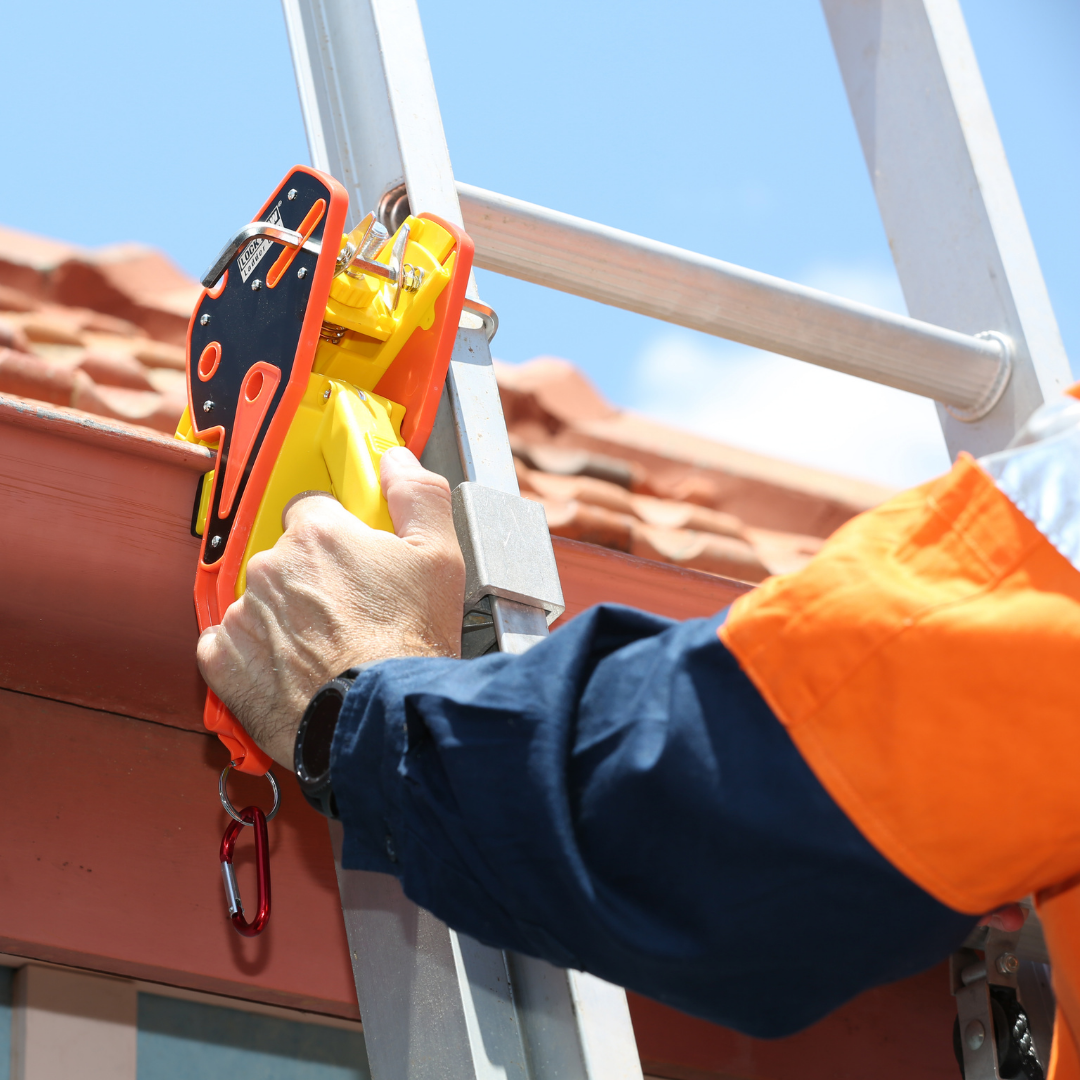
If your job involves gutters or roof access, the Lock Jaw Ladder Grip is endorsed here as the best option because it is designed to secure a ladder to a gutter quickly and help reduce the kinds of movement that commonly lead to slips and falls.
In practical terms, it can help by:
Locking onto a gutter fast, so the top of the ladder is less likely to shift
Helping stabilise the ladder during climbing and roof access
Supporting safer access habits when you need to get up and down repeatedly
If you want to learn more about what sets it apart, start at the Lock Jaw Ladder Grip home page, then review the Australian overview at the Lock Jaw Ladder Grip page in Australia and the gold standard award-winning ladder safety page.
What Everyday Habits Reduce Ladder Risk Every Single Time?
Ladder safety is mostly habits, not heroics. These are small changes that matter.
Try these:
Move the ladder instead of leaning your body sideways
Keep your belt buckle between the rails to avoid overreach
Keep both feet on the same rung, never one foot reaching
Use a tool belt or tool bag instead of carrying tools in your hands
Take breaks if you are fatigued or rushing
Keep the base area clear so no one bumps the ladder
Avoid ladder work in wind or rain if stability is reduced
Do not “just do it quickly” if the setup feels off
If something feels unstable, treat that feeling as a warning, not a challenge.
What Should You Do If Something Feels Unsafe Mid-Job?
This is one of the most important ladder safety rules: you are allowed to stop.
If the ladder shifts, the ground softens, or you feel unstable:
Stop climbing immediately
Hold position and regain balance
Climb down slowly using three points of contact
Reset the ladder setup properly
Consider a different access method if the job is too complex for a ladder
Ladder injuries statistics exist because too many people kept going when they should have reset.
What Is the Most Practical Takeaway From Ladder Injuries Statistics?
Here is the simplest conclusion:
Ladder injuries statistics show that falls are common, often serious, and frequently linked to preventable factors like ladder movement, poor setup, and rushed habits.
The good news is that prevention is not complicated. It is a sequence:
Choose the right ladder
Inspect it
Set it up properly
Keep three points of contact
Stabilise the ladder at the top and base
Use the right safety device for the job when needed
When you treat ladder safety like a routine, not a reaction, your risk drops fast.
Call to Action: What Is the Best Next Step If You Want Safer Ladder Access Today?
If you want a practical way to help reduce ladder movement during gutter and roof access, start here: Lock Jaw Ladder Grip. If you have questions about fit or your use case, reach out via the contact page.
What Sources Support These Ladder Injuries Statistics?
Works Cited (MLA)
Australian Institute of Health and Welfare. “Injury in Australia: Falls.” Australian Institute of Health and Welfare, 25 Nov. 2025.
Better Health Channel. “Ladder Safety Matters.” Better Health Channel, 25 Nov. 2021.
Safe Work Australia. “Key Work Health and Safety Statistics Australia 2025: Latest Release.” Safe Work Australia Data, 16 Oct. 2025.
Safe Work Australia. “Work-Related Injuries and Fatalities Involving a Fall from Height, Australia.” Safe Work Australia, Feb. 2013.
Vallmuur, K., et al. “Falls from Ladders in Australia: Comparing Occupational and Non-Occupational Injuries Across Age Groups.” Emergency Medicine Australasia, 2016.
Lock Jaw Ladder Grip. “Lock Jaw Ladder Grip - Single Pack.” Lock Jaw Ladder Grip.